Posts

Remembering Christopher Hill

  Remembering Christopher Hill I first came across Christopher Hill in the Hilary Term (January to March) of 1963 when I attended lectures he gave in the dining hall of Balliol College, Oxford. These were based on the material he later published in 1964 in his book, Society and Puritanism in Pre-Revolutionary England . I was very surprised by his delivery of these lectures given in a rather flat, even-paced voice punctuated by copious quotations from printed sources and accompanied by an interpretation of this period in a form of soft determinism. Rather disconcertingly, every two or three sentences he would sniff as if to punctuate his remarks. It was more of a surprise to me in October, 1965 when he was assigned as my supervisor by the History Faculty Board for my prospective work on the 2nd Earl of Warwick. At our first meeting, he enquired after my social background and about my watch, which was one of the very first to provide the date as well as the time, and what it had cost...
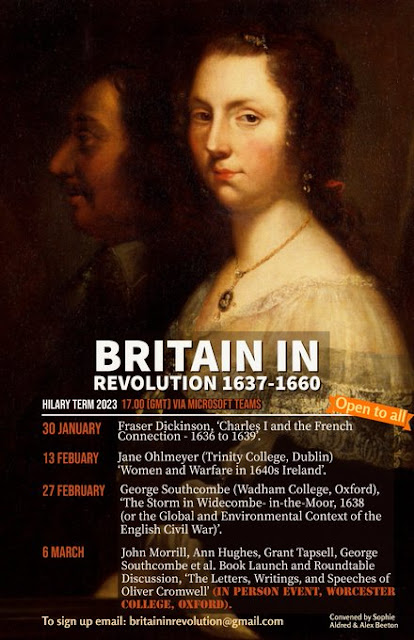
Britain in Revolution 1637-1660 seminar programme (University of Oxford for Hilary Term)

Image
 

Christopher Hill

I understand today from Glenn Burgess (University of Hull) that Michael Braddick (University of Sheffield) is writing a biography of Christopher Hill.

Memorializing Christopher Hill

 Memorializing Christopher Hill I have been wondering for several years about the renewed interest in the influence and writings of Christopher Hill, the Marxist historian of the seventeenth-century England – particularly of the events of the 1640s and 1650s – and the former Master of Balliol College, Oxford. An annual lecture in his memory has been established and there is planned to be a conference on his book, The World Turned Upside Down, published just over fifty years ago at the Institute of Historical Research in London on 4th February. I have heard that some of his correspondence held in Balliol’s College’s Library may be published but how reliable this report is cannot be verified. Is this interest in Hill accidental or is there a network of scholars engaged in promoting this interest in Hill’s oeuvre?  Posted on the academia.edu site as a comment yesterday.

March, 1640 Short Parliament election

  Reflecting on the county election for the Short Parliament in Essex in March, 1640     “ Sr Wm Masham motioned yt ye countees might have freedom in yr election of Burgesses, and Lords or Justices not intermeddle in it” (British Library. Harleian Ms.4931 , fol.47r. 16 April, 1640) 1     The election of Members of the House of Commons in March, 1640 is well known from the surviving accounts of Sir Humphrey Mildmay of Danbury in his diary 2 , from the protest made by William, Lord Maynard, the county’s joint Lord Lieutenan t 3 , to Sir Thomas Barrington of Hatfield Broad Oak, one of the victorious candidates, shortly after polling day, and from the observations of Henry Nevill of Cressing Temple, who had been defeated in the contest, just over two weeks later 4 . All of them were unsympathetic to t he patron of the victorious candidates, Sir Thomas Barrington and Sir Harbottle Grimston, namely, Robert Rich, 2 nd Earl of Warwick , and shared concerns over the...

Christopher Gillett's review of Eilish Gregory's book, Catholics during the English Revolution 1642-1660 (H-Net) pasted

  Gillett on Gregory, 'Catholics during the English Revolution, 1642-1660: Politics, Sequestration and Loyalty' by  H-Net Reviews Eilish Gregory.   Catholics during the English Revolution, 1642-1660: Politics, Sequestration and Loyalty.  Woodbridge, Suffolk: Boydell & Brewer, 2021. 248 pp. $115.00 (cloth), ISBN 978-1-78327-594-6. Reviewed by  Christopher P. Gillett (The University of Scranton)  Published on  H-Albion (November, 2022)  Commissioned by  Jeffrey R. Wigelsworth (Red Deer Polytechnic) Printable Version:  https://www.h-net.org/reviews/showpdf.php?id=57696 Eilish Gregory’s  Catholics during the English Revolution, 1642–1660  offers the first book-length analysis of how the English Catholic laity attempted to navigate the penal laws, particularly the economic penalties of sequestration and compounding, during the mid-seventeenth century. Gregory situates her volume as part of an attempt to bridge a chronological ga...

Conference on Christopher Hill's WTUD is to be re-scheduled

 I have just heard that this conference due to be held at the Institute of Historical Research in London on Saturday, 26th November, 2022 is to be moved to a date between December, 2022 and February, 2022.