Posts

The rise in Virginia's population from 1618 to April, 1619 and the implications for the 'public stores' of cattle and corn

  Migration to Virginia in 1618-1619 The instructions given by the Virginia Company in November, 1618 to George Yeardley, its newly chosen prospective Governor of its transatlantic colony, survive in more than one version. The first formal set can be found in Volume 3 of the company’s records edited by Susan Myra Kingsbury and published in 1933. [1] The second related set of instructions for the restoration of the company’s store of cattle and corn is located in the Ferrar Papers held in Magdalene College, Cambridge and much more recently transcribed by David Ransome. [2] They are not identical but they do share common characteristics. That edited by Kingsbury begins with the proposition that “our trust being that under the Government of you Captain Yeardly with the advice and assistance of the said Council of State [to be established in Virginia] such public provisions of Corn and Cattle will again be raised as may draw on those Multitudes who in great Abundance from diverse...
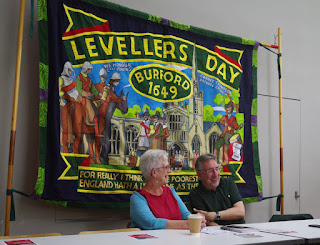
Levellers' Day at Burford in Oxfordshire (Saturday, 21st May, 2022)

Image
Ann Hughes and John Rees  

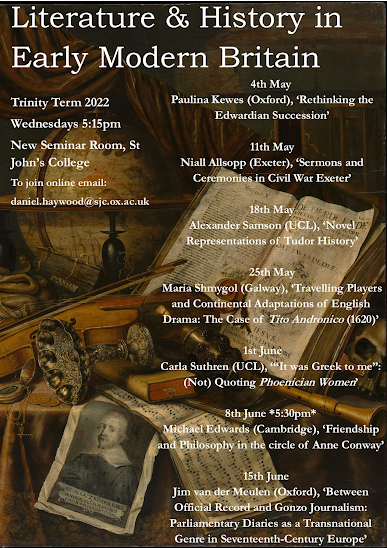
Oxford University seminar on Literature and History in Early Modern Britain (pasted)

Image
 

Parliamentary diaries in 1624 and 1642-1643

I have just put up on my academia.edu page my 1985 transcripts of the Holles and Rich accounts of proceedings in the House of Commons in 1624 and my transcript from 1985 and 2000 of Walter Yonge's notes on proceedings in the House of Commons between 19th September, 1642 and 7th March, 1643.

Contesting the Church in England c.1640-c.1670: University of Kent Conference 21st May, 2022

Image
  Centre for Anglican History and Theology University of Kent 21 st May 2022   Contesting the Church in England c.1640-c.1670     Between 1640 and 1670 the church in England underwent a series of traumatic changes in form and governance. Experiments in religious worship that were tolerated during the civil wars were viewed with horror by loyal episcopalians. When the monarchy was restored in 1660, strenuous attempts were made to stamp out religious non-conformity, but it was too late. A generation had grown up experiencing greater religious freedom and rejected attempts to re-instate the pre-civil war national church. The conference offers a forum for discussing new research and sources on the conflicting views of what the national church should be before and after the restoration, and asks the question: ‘Whose church was it, anyway?’           Conference...

Two Notes on Virginia in 1618-1619

  The revised instructions of 2 nd December, 1618 to Sir George Yeardley This document, which is now numbered FP 100 amongst the Ferrar Papers in Magdalene College, Cambridge, elaborates on the instructions given to George Yeardley on 18 th November, 1618. It incorporates advice apparently given to Yeardley when he was knighted at Newmarket on 22 nd November by King James VI and I. But it also contains provisions which suggest that, despite later claims by ‘R.F.’ on 7 th December, 1618 and in current historiography, Sir Edwin Sandys and his allies had had to take account of the views of other groups in the leadership of the Virginia Company of London. For example, item No.27 instructed Yeardley upon his arrival in Virginia to settle Martin’s Hundred in its ‘Circuit of land, with those privileges granted unto them: whereof they give you a brief.’ Since the patent for Martin’s Hundred largely exempted that plantation from the control of the colony’s local government, this provi...

Carol Levin's review on H-Albion of G.W.Bernard's book, Who Ruled Tudor England (available under a Creative Commons Licence)

  Levin on Bernard, 'Who Ruled Tudor England: Paradoxes of Power' Author:  G. W. Bernard Reviewer:  Carole Levin G. W. Bernard.   Who Ruled Tudor England: Paradoxes of Power.  London: Bloomsbury Academic, 2021. 240 pp. $103.50 (e-book), ISBN 978-1-350-17691-1; $115.00 (cloth), ISBN 978-1-350-17689-8. Reviewed by  Carole Levin (University of Nebraska--Lincoln)  Published on  H-Albion (April, 2022)  Commissioned by  Jeffrey R. Wigelsworth (Red Deer Polytechnic) Printable Version:  https://www.h-net.org/reviews/showpdf.php?id=57256 G. W. Bernard’s  Who Ruled Tudor England: Paradoxes of Power  is a highly readable and thoughtful book, the core of which is serious criticism of Geoffrey Elton and his work on Thomas Cromwell and the Tudor revolution of government. Though the title is “Who Ruled Tudor England,” most of the book focuses on the reign of Henry VIII. One of the most interesting and unusual parts of this book is part 1...