Posts

Andrew Hopper, The Human Costs of the British Civil Wars (BALH Lecture 9 December, 2021) (pasted)

BALH Winter Lecture: The Human Costs of the British Civil Wars Date / time 9 December, 7:00 pm BALH Winter Lecture: The Human Costs of the British Civil Wars A special BALH event with a talk by Andrew Hopper, Professor of Local and Social History in the Department for Continuing Education at Rewley House, University of Oxford. The British and Irish Civil Wars (1638–1652) are now taking centre stage as a critical event in the welfare history of Europe. During these conflicts, the Long Parliament implemented a national pension scheme for those who had suffered ‘in the State’s service’. Maimed soldiers no longer able to work, bereaved war widows and orphans too could petition Justices of the Peace for a pension on a local level, through the county quarter sessions courts. For the very first time, this signified the state’s acceptance of a duty of care to both its servicemen and their families. The impact of war-related deprivation was widespread, given that civil-war population loss...
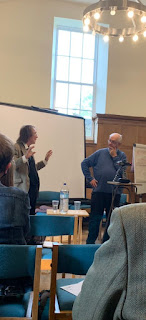
Ronald Hutton and John Morrill in debate at the Cromwell Association meeting in Oxford last Saturday

Image

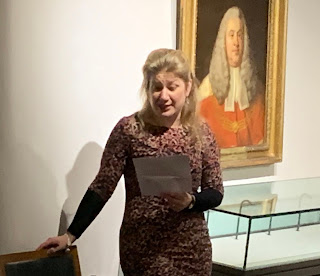
Launching Devil Land at Trinity Hall, Cambridge

Image

Clare Jackson's Devil Land

Clare Jackson is a Cambridge historian probably best known for her BBC documentaries on the rule of the Stuarts in the British Isles between 1603 and 1714. The publication of her book, Devil Land: England Under Siege 1588-1688 , this summer marks the completion of an enterprise foreshadowed two years ago at the Chalke Valley History Festival. Now that it has been completed, she has given an interview to Ellie Cawthorne summarised in the November issue of the BBC History Magazine and available in a fuller form on the History Extra website. Her focus, Clare Jackson explained, had been on the insecurities faced by England in the century after 1588, insecurities, for example, over the succession to Queen Elizabeth or over uncertainties about the religious settlement and the possibility of a return to Catholicism. Foreign invasions via Ireland or Scotland or England's coastal ports were a recurrent anxiety for rulers and ruled alike. On the continent, Protestantism was in retreat under ...

IHR seminar 4th October, 2021

  Late in the afternoon last Monday (4 th October, 2021), I sat in on the Institute of Historical Research's Tudor and Stuart seminar. The paper was given by William Deringer of the Mssachusetts Institute of Technology on the subject of the development of mathematical tables for calculating the appropriate levels for entry fines and rents on church properties, mainly in the diocese of Durham, in the period after 1600.  I was puzzled by several aspects of his argument, partly, for example, by his citation of R.H.Tawney and Lawrence Stone as authorities on leasing practices in England in the early modern period and by his belief that rack-renting was possible when leases of 21 or more years were granted. There were other features of leasing – the use of provision rents on ecclesiastical and secular properties down to c.1600, leases that allowed tenants to receive profits from manorial courts rather than these being received by landlords, the difficulties faced by landlords and ...

Seventeenth-century British History seminar at the IHR: autumn programme 2021 (pasted)

Image
  Term 1- Autumn 2021 07 oct 2021 Making peace in the English Civil Wars William White (York) Online- via Zoom 21 oct 2021 "I have sent you the book of nus": gender, identity and news cultures in seventeenth-century England Hannah Jeans (York) Online- via Zoom 04 nov 2021 Forging identity through death: the Quaker dead of seventeenth-century London Anna Cusack (Birkbeck) Online- via Zoom 18 nov 2021 The great hedgehog massacre: vermin eradication and popular improvement in early modern England Will Cavert (University of St Thomas, Minesotta) Online- via Zoom 02 dec 2021 William Laud vs the English print underground, 1628-1637 William Clayton (UEA) Online- via Zoom 16 dec 2021 The Bothwell Depositions of 1679: rethinking the “Covenanters” of Restoration Scotland Laura Doak (Dundee) Online- via Zoom

John Adamson's review of Eilish Gregory, Catholics During the English Revolution, 1642-1660

  John Adamson on Eilish Gregory’s book, Catholics During the English Revolution, 1642-1660: Politics, Sequestration and Loyalty (Boydell Press, 2021) Given the number of historians in this country and elsewhere working on the events of the 1640s and 1650s in the British Isles and the ever-growing body of their publications, it is not surprising that it has become increasingly difficult to keep up with the flow of articles, books and reviews coming from their word-processors. Even with the aid of Google’s alerts and daily checks on social media like Twitter, some items of interest are inevitably missed. That was certainly the case for John Adamson’s review in the Catholic Herald in August of Eilish Gregory’s recent book on the sequestration of Catholics’ estates in the English Civil War and the immediately succeeding period. [1] John Adamson’s review began with a brief account of long-standing fears about Catholic attempts to subvert England’s liberties and Protestantism stret...